Categorie
Nuovo blog
A Bubble in the Adhesive Is Sealed for Good the Moment It Cures
Oct 22, 2026Why automotive and aerospace customers write vacuum degassing into their process requirements?
A bubble 0.3 mm across sits in the adhesive layer, invisible to the eye and not always caught by AOI. It stays there quietly until the product goes through its first thermal cycle — and then it becomes a rework, a claim, or a recall.
1. It is not a cosmetic defect — it is a reliability issue
Under thermal cycling a bubble expands and contracts repeatedly, changing volume far more than the surrounding cured material. Stress builds at the interface and eventually shows up as delamination, micro-cracks or debonding; at the same time the bubble reduces the effective adhesive thickness and the creepage distance, so insulation performance drops.
Customers set very specific criteria: single-bubble area ratio, total projected area ratio, and zero bubbles in critical areas. Fall short and it is not “watch it next time” — the whole lot is held.
2. Degassing the adhesive alone covers only a third of the problem
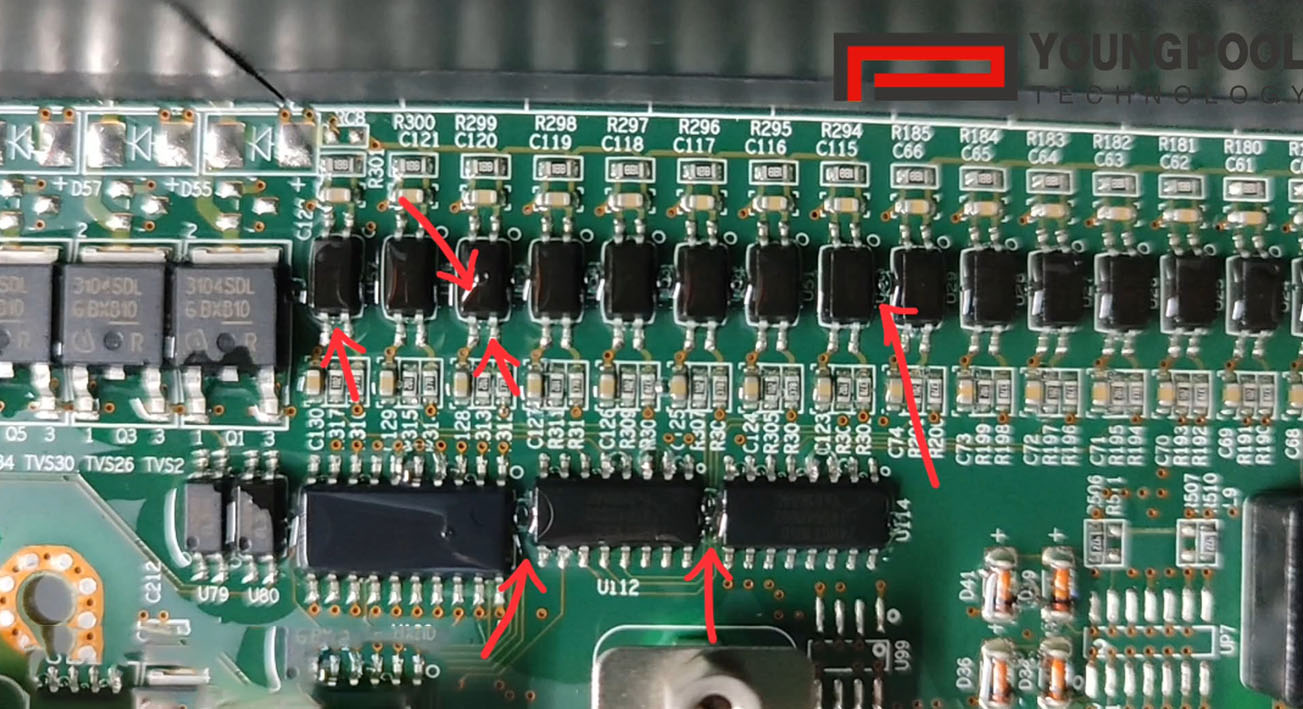
Bubbles come from three places: the adhesive itself, the refilling step, and entrainment during dispensing. The first two live in the adhesive path; the third happens on the board. And there is a fourth that is often missed — solder mask texture, vias and the steps under components physically trap air.
The decisive factor is the time window. While the adhesive is still liquid, a pressure differential can pull bubbles out. Once cured, the bubble becomes a permanent void, and the only remedy left is reworking or scrapping the whole board.
3. How the N-800A closes each of these gaps
▪ Inline: installed between dispensing and curing — no batching, no off-line detour.
▪ Single track, single chamber: each board is processed on its own, so an edge board never sees a weaker vacuum.
▪ Adjustable vacuum profile: vacuum level and dwell time are set as a recipe per adhesive and board type, so a new material does not mean a new machine.
4. A European customer — and the step you can take now
A European electronics manufacturing services (EMS) provider ran into the same bottleneck: its customer had explicit acceptance criteria for bubbles in the adhesive layer, while the existing process was already close to its limit. The questions it asked were not about price, but three things — can bubbles be removed before curing, can one machine cover different adhesives and board types, and can it fit the existing line takt. Once the principle and the inline configuration were confirmed, the decision came quickly.
The most direct way to find out whether vacuum degassing helps you is not to read more material, but to run a sample: send us a dispensed sample, or book an on-site trial, and we will run a before-and-after comparison with your adhesive and your board and propose vacuum and dwell settings.
When bubbles become an acceptance item, degassing stops being an improvement project and becomes an entry requirement.
Youngpool N-800A Vacuum Degassing Machine
Hotline: +86 181 2417 2940 (WeChat) | www.youngpool.com


 Rete IPv6 supportata